Could a farmer broadcast barley before anyone owned a radio? A museum editor checking that sentence needs a different kind of evidence from a colleague deciding how to spell judgment.
For everyday American copy, I’d keep Merriam-Webster open. When a verb sounds awkward in a sentence, I’d reach for Cambridge Dictionary. And when the accuracy of a claim turns on what a word meant a century ago, I’d start with the Oxford English Dictionary (OED). Here’s how those choices hold up on the same three jobs at an imaginary radio museum.
Which dictionary should I open?
Merriam-Webster
Check the headword, its variants, and any usage labels. A practical first stop for a U.S. editor.
Cambridge Dictionary
Look beside the relevant sense for a grammar pattern. Read an example aloud with your own words in its place.
Oxford English Dictionary
Trace a particular meaning through dated evidence. Match the part of speech and the sense before citing a year.
Judgment or judgement?
The exhibition catalog says the selection panel exercised “sound judgement.” A proofreader circles the second e. Is that a spelling error, or does the museum simply need to pick a form?
- Merriam-Webster
- The headword is judgment. The entry also lists judgement as a variant. That gives a U.S. editor a sensible default and a reason to query a blanket correction. See the spelling line.
- Cambridge
- Read the headings as you move down the page. The Business English section identifies judgement as a UK spelling of judgment. The label helps explain why another editor might expect the extra letter. Compare the Cambridge entries.
- OED
- Both forms appear together in the heading, judgement | judgment. That’s good evidence that both belong to the word’s record. The order of the pair answers a different question from the one on a U.S. proof. See the OED heading.
The selection panel exercised sound judgment.
I’d enter judgment on the museum’s style sheet and apply it consistently in the museum’s own prose. I’d keep the original spelling in a quotation or an artwork’s title. If you edit for a publication with an existing style sheet, check that first. The Associated Press, for example, names Merriam-Webster as its first dictionary reference for matters its Stylebook leaves open. Read AP’s reference policy.
What comes after recommend?
A conservator writes, “We recommend to repair the radio before the exhibition.” Everyone understands the advice. The snag comes where recommend meets the proposed action. Looking up a synonym won’t tell us how those pieces fit.
- Merriam-Webster
- The advice sense fits. In the examples, a recommendation about changing oil appears with a that-clause. You can borrow that structure and supply the person responsible for the repair. See the usage examples.
- Cambridge
- The entry marks the advice sense with patterns for an -ing verb and a that-clause. Its grammar guide addresses the exact snag in the draft. When the proposed action immediately follows recommend, use repairing. See the pattern labels · Read the grammar note.
- OED
- The historical verb entry has 19 senses, eight labeled obsolete. That depth would matter if we were interpreting an old conservator’s letter. For the memo on our desk, Cambridge puts the two usable patterns beside the sense we need. Read the verb factsheet.
We recommend repairing the radio.
We recommend that the museum repair the radio.
The first version keeps the action in focus. The second names who should take it. In the second, repair is the base form used after a recommendation in this construction. Read it next to “The museum repairs radios,” which describes what the museum does.
What did people broadcast before radio?
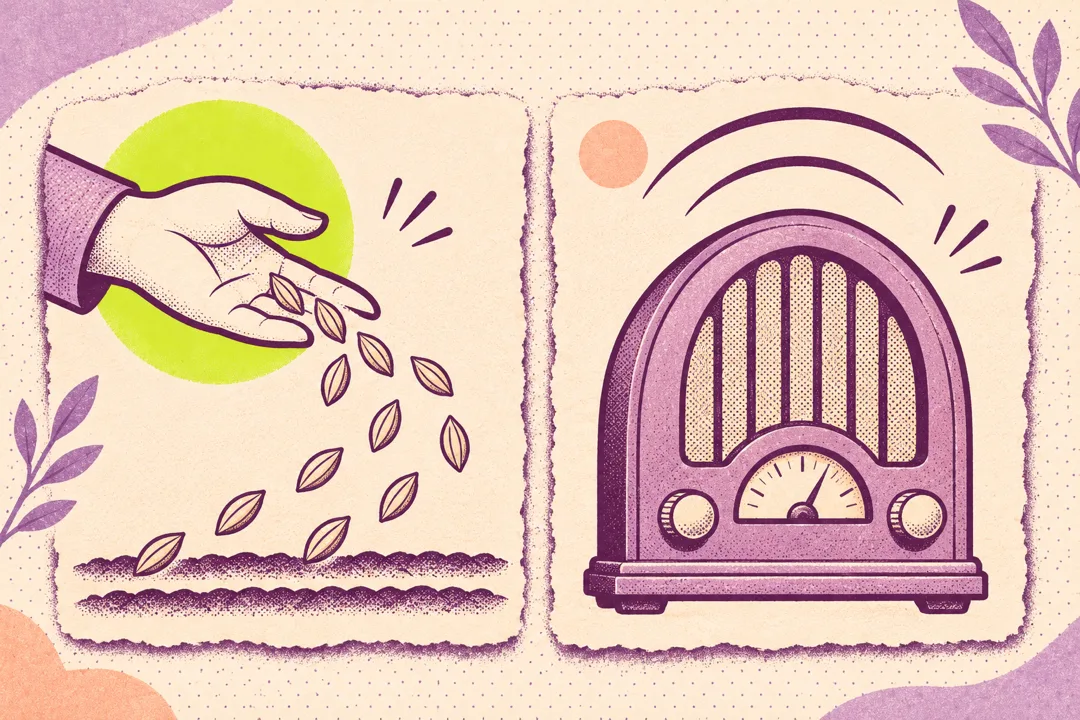
A draft wall label gives radio credit for inventing the verb broadcast. It sounds plausible if the first thing you picture is an announcer leaning into a microphone. Merriam-Webster and Cambridge both record an agricultural sense, but they put it in different places.
- Merriam-Webster
- Under the verb, scattering seed appears before transmitting a program. The entry’s first-known-use date for the verb points to that agricultural sense. The noun has a history of its own. Check the verb and its date.
- Cambridge
- The verb entry leads with radio or television. Scattering seed appears farther down the page. Even two dictionaries that record both meanings can introduce them in a different order. Compare Cambridge’s sense order.
- OED
- The verb factsheet identifies William Ellis’s 1733 agricultural use as its earliest evidence and dates the broadcasting use to the 1910s. When you have full access, open Meaning & use and read the quotations attached to the particular sense you plan to cite. Inspect the OED factsheet.
William Ellis describes how to sow barley across harrowed ground. The thing being spread is grain.
On December 27, The Baltimore Sun reports that U.S. Navy radio stations broadcast warnings about hazards to navigation. The thing being spread is a message.
Merriam-Webster reproduces both period passages in its history of broadcasting and narrowcasting.
Long before radio stations broadcast warnings to ships, farmers broadcast seed across their fields.
The dates give us two things a museum can defend in print. The farming use was in writing by 1733, and the radio use was in writing by 1912. To claim that someone coined the word in either year, we’d need evidence about the act of inventing it. A dated passage documents someone using it.
Do you need a paid dictionary?
The Merriam-Webster and Cambridge entries used here are free to read. For a writer checking a spelling or a sentence pattern, I’d bookmark those two first. The OED earns its place when you regularly need to interpret old texts, distinguish obsolete senses, or document when a particular meaning was in use.
The OED’s public factsheets give you a starting point. Full entries and their quotation evidence can require a subscription. Before paying, check the databases on your public or university library’s website and follow its OED link. Look for the full title Oxford English Dictionary. Oxford also publishes learner’s dictionaries, which serve a different purpose. Check Oxford’s access options.
Make the call
What would you put in print? Choose one answer per question. Open each choice to see the editorial reasoning.
1. The museum’s style sheet specifies catalog. A dictionary also lists catalogue. Which spelling belongs in a new museum caption?
A. Catalogue, because formal writing calls for the longer spelling.
Incorrect. Word length tells us nothing about formality here. The museum has already selected its spelling.
B. Catalog, to follow the museum’s style.
Correct. The style sheet settles this choice for the museum’s own prose. The dictionary explains why another publication might legitimately choose differently.
C. Alternate the two to avoid repetition.
Incorrect. Variation in the spelling of the same word would introduce an inconsistency into these captions.
D. Use whichever appeared in last year’s brochure.
Incorrect. An older brochure can contain an oversight or reflect a previous policy. The current style sheet gives the instruction for this caption.
2. What evidence most directly supports “We recommend replacing the seal”?
A. A thesaurus lists advise as a synonym.
Incorrect. Words with similar meanings can take different grammatical patterns.
B. The headword is labeled verb.
Incorrect. That identifies the part of speech. We still need to know what can follow this particular verb.
C. The verb is labeled transitive.
Incorrect. That label tells us the verb can take an object. By itself it does not specify the form of the proposed action.
D. The advice sense shows recommend followed by an -ing form and gives a matching example.
Correct. The pattern and example address the exact point under revision. Substitute replacing the seal for the action in the example.
3. A dated 1912 report uses broadcast for sending a radio warning. What can an editor safely conclude from that passage alone?
A. The radio sense was in use by 1912.
Correct. The passage documents this meaning at that date. An earlier example could still turn up.
B. The reporter invented the radio sense in 1912.
Incorrect. Using a word in print provides no evidence that the writer coined the usage.
C. Radio was the word’s most frequent meaning in 1912.
Incorrect. One occurrence establishes use. Relative frequency requires a representative collection of examples.
D. The agricultural sense had fallen out of use by 1912.
Incorrect. A passage about radio says nothing about whether farmers still used the word for sowing.