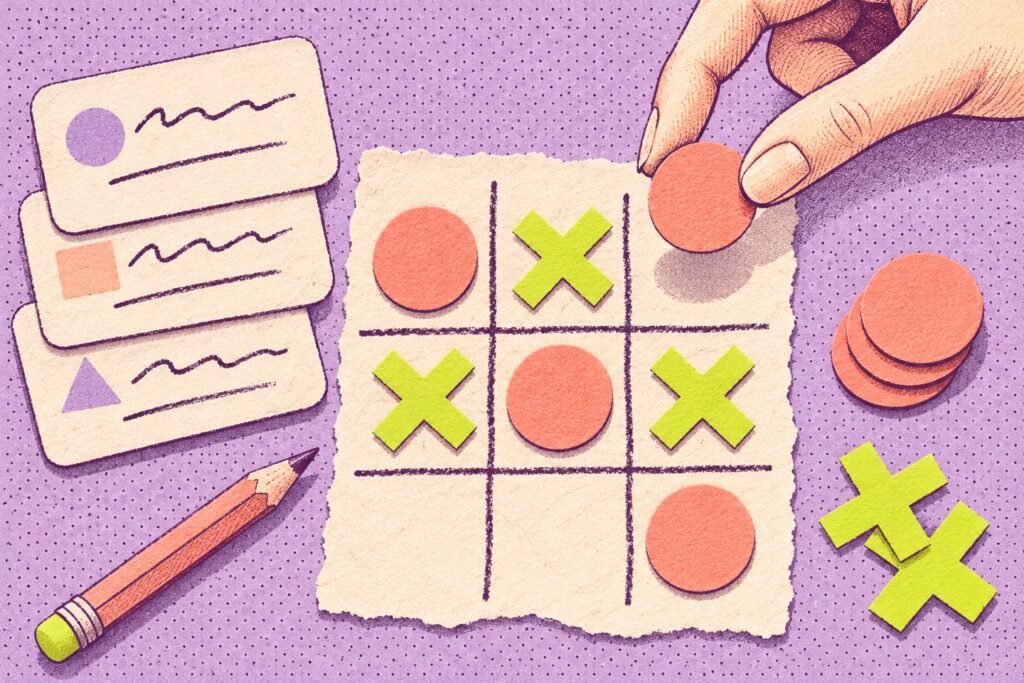
Start with grammar tic-tac-toe when you have five minutes and a rule to review. Draw nine squares, give each square a sentence to fix, and let a team claim a square after it explains its edit. Choose grammar bingo for recognizing parts of speech, fill-in-the-blank stories for building sentences, or a grammar escape room for a longer review.
The 10 classroom grammar games below include rules, sample prompts, and answers. Most work with a board, paper, or a shared slide. For a first round, choose one skill your students have already practiced and model one turn aloud.
Choose a game
| Time to play | Skill to review | Try |
|---|---|---|
| 5–8 minutes | Correct a sentence and explain the edit | Grammar tic-tac-toe |
| 8–12 minutes | Identify word classes in context | Grammar bingo or charades |
| 10–15 minutes | Build sentences and change verb forms | Word tiles, fill-in-the-blank stories, or sentence tower |
| 10–15 minutes | Recall and use grammar vocabulary | Grammar crosswords |
| 12–25 minutes | Review a unit or work through a series of edits | Team quiz, relay, or escape room |
Quick grammar games
1. Grammar tic-tac-toe
Draw a tic-tac-toe grid and number the squares 1–9. Write one short prompt for each square. Teams alternate choosing a square. Before the team can mark its X or O, its players agree on a correction, and one player explains it. If the team misses, leave the square open and pass the turn. The first team with three in a row wins.
Try this square. The list of ingredients are on the fridge. A player claims the square with The list of ingredients is on the fridge and points to list, the singular noun that determines the verb. See the subject–verb agreement guide for more patterns to practice.
Copy nine agreement prompts and the answer key
- The list of ingredients (is / are) on the fridge.
- The boxes of chalk (is / are) in the cupboard.
- The owner of both shops (is / are) at the counter.
- The list of ingredients (has / have) a typo.
- The boxes of chalk (has / have) labels.
- The owner of both shops (has / have) the keys.
- The list of ingredients (seems / seem) incomplete.
- The boxes of chalk (seems / seem) heavy.
- The owner of both shops (seems / seem) busy.
Answer key. 1. is · 2. are · 3. is · 4. has · 5. have · 6. has · 7. seems · 8. seem · 9. seems. The nouns that determine the verbs are list, boxes, and owner.
For pairs. Give each pair the grid and keep the key folded. Ask both players to solve each prompt before they compare answers and check the key.
2. Grammar bingo
Give each player a 3 × 3 grid. Ask them to fill the squares in any order with noun, verb, adjective, adverb, pronoun, preposition, conjunction, article, and interjection. Read a sentence and display or repeat its target word. Players mark the word’s category in that sentence. The first player with three in a row reads back the categories and identifies the target words that earned them.
Model a call. In The bus stopped near the corner, call out near. Players mark preposition because near links the location of the stop to the corner. When you choose new words, provide a sentence each time. A word can belong to different classes depending on how it’s used. Cambridge Grammar on word classes
Nine bingo calls and their answers
- The bench needs paint. → noun
- The door creaks in the wind. → verb
- We picked the blue folder. → adjective
- Rosa closed the door quietly. → adverb
- They missed the bus. → pronoun
- We waited under the awning. → preposition
- I called, but nobody answered. → conjunction
- We brought an umbrella. → article
- Oops, I left my keys inside. → interjection
With newer readers. Draw a 2 × 2 card and use four familiar categories. Show each sentence while you read it.
3. Grammar charades
Put actions such as fold a letter, stir a pot, and carry a tray on cards. Put adverbs such as carefully, slowly, and impatiently on a second set. A player draws one of each and mimes the action and manner. A team earns a point when it gives a full sentence and identifies the word or phrase that describes how the action happened.
Model a turn. Mime carrying a tray carefully. A player might say He carried the tray carefully and explain that carefully describes how he carried it. Accept with great care as another way to express the manner. If the goal is to identify single-word adverbs, ask the player to supply carefully as well.
Play from a seat or online. Let players act with their hands, choose from pictures, or describe what the actor did in the chat. For movement-based lessons and stations, see hands-on grammar activities.
Word and sentence games
4. Scrabble with a grammar twist
Give each group a set of letter tiles or paper letters. Players draw a hand of letters and build a word. A word earns a point when its player uses it in a sentence that fits the round’s target, such as a past-tense sentence or a sentence with an adjective. The next player can use the same word in a different grammatical role for a bonus point.
Try light. In The light above the stairs flickered, light is a noun. In I packed a light jacket, it’s an adjective. In We light the candles after dinner, it’s a verb. Ask players to point to the words around it that support their answer. If making words takes most of the round, give teams six ready-made word cards, including plant, paint, and watch.
5. Fill-in-the-blank stories, Mad Libs style
Read the blank labels first and collect the words before showing the story. Read the result aloud. The team scores a point for each form that fits, then revises any form that needs to change. An absurd story can still be grammatical.
Use this story frame. “Yesterday, we [past-tense verb] near the park. A [adjective] [singular noun] [past-tense verb] toward us. We [past-tense verb] [adverb of manner].”
Try a finished version. Yesterday, we danced near the park. A sleepy robot rolled toward us. We waved nervously. If a team chooses owl and elegant for the second sentence, have them change a to an. The choice depends on the sound that immediately follows the article. Give older learners a short news brief or trip report to fill in and edit. Guide to articles and other common grammar challenges
6. Sentence structure Jenga
Label blocks or cards subject, verb, direct object, and time phrase. Start with a sentence everyone can see. On each turn, the player draws a labeled piece and changes that part of the sentence. A point goes to any player who reads a grammatical revision and explains a second change the edit required. If there’s no second change, ask the player to explain why the other words can stay.
Start with The photographer checks the batteries every morning. A player draws subject and replaces the photographer with the assistants. Now the sentence reads The assistants check the batteries every morning. The change from singular to plural also changes checks to check.
Use a stack of cards for a quieter round. Keep the same turn and scoring rules. With advanced writers, add cards for introductory clause or relative clause.
7. Grammar puzzles and crosswords
Write clues that ask players to name what a word does in a sentence. After solving a clue, players earn a point by writing a new sentence that demonstrates the same idea. To make a tiny crossword, draw four squares across and seven down. Make the fourth across square and the third down square the same square.
- Across, four letters. Name the word class of stop in The buses stop here.
- Down, seven letters. Name the part of The buses stop here that determines the form of stop.
Crossword answers and a sample sentence
Across is verb. Down is subject. They cross at b. In The train stops here, the train is the subject and stops is the verb.
For a word search. Hide the answer terms in a grid. Give players the sentence clues first, then let them confirm their answers in the grid.
Team grammar games
8. Jeopardy-style grammar quiz
Draw three columns labeled Word Classes, Verb Forms, and Punctuation. Put a 100-point identification prompt and a 200-point editing or writing prompt in each column. Teams take turns choosing a prompt. Give everyone a short moment to write an answer before the choosing team responds. Award the points for a correct answer, and use the explanation to settle close calls.
Build one column. For 100 points, show We ate lunch early and ask for the past-tense verb. The answer is ate. For 200, ask the team to rewrite it as a question beginning with Did. The answer is Did we eat lunch early? The past-tense marking is on did, so eat uses its base form. Use the English tenses guide to choose forms for future rounds.
9. Grammar relay races
Give each team an envelope with three numbered sentence strips. Player one edits strip one and passes it to player two, who checks the edit and takes the next strip. Continue around the team, then pass the final strip back to the first player to check. Each strip should have an editor’s and a checker’s initials. Give one point per correct edit and one per explanation. Set a shared stopping time so teams can finish together.
Try a comma-splice relay. Pass one strip with The bell rang, we packed up. through all three players. Ask the first player to make two sentences, the second to join the clauses with and, and the third to explain what the first draft did. Model answers are The bell rang. We packed up. and The bell rang, and we packed up. The original used a comma alone between two independent clauses. Purdue OWL on comma splices
Keep it at the table. Pass the envelope from seat to seat. Online, use a shared document and assign an editor and checker for each strip.
10. Grammar escape room
Put three numbered envelopes on each team’s table, or create three slides. Each puzzle gives a choice and a matching letter. Teams earn the letter by choosing the answer and explaining it. The letters in order form a key word that unlocks the final envelope or slide. Give a hint when a team can identify the relevant part of a sentence but still needs help choosing the form.
- Yesterday, Priya (A) takes / (K) took the early bus. Choose the verb.
- The handle on those bags (E) is / (O) are torn. Choose the verb.
- After the rain stopped ___ we went outside. For the blank, choose (Y) a comma or (T) no punctuation.
Escape-room key and final clue
KEY. Took describes a completed past action here. Is agrees with handle. The comma follows the introductory dependent clause After the rain stopped.
Inside the final envelope, ask players to respond to this prompt. Write a sentence about your morning that begins with an introductory dependent clause. Put a comma after the clause. One answer is When the kettle clicked off, I poured the tea. Guide to comma rules
Check understanding after the game
Give everyone one fresh sentence to edit or write on their own. After an agreement game, try The signs outside the gym (needs / need) new paint and ask students to underline the noun that controls the verb. The answer is need because signs is plural. If several students choose needs, compare the sentence with The sign outside the gym needs new paint before the next round.
For mixed groups, display prompts as well as reading them aloud. Let students explain by speaking, writing, or pointing to the relevant words and choosing a reason. With older students or adults, use sentences from schedules, emails, or notices and ask players to explain how each change helps the reader.
For a full lesson sequence, see how to teach grammar effectively or explore The Art of Grammar courses.