

The Evolution of English Grammar
In the tapestry of language, few threads are as intricate and evolving as the grammar of English. From its early roots in the mists of Anglo-Saxon England to the global lingua franca it has become today, English grammar has undergone profound transformations, reflecting shifts in culture, power, and technology. This journey, spanning over a millennium, reveals not just the adaptability and resilience of English but also mirrors the changing societies shaped by this dynamic language. “The Evolution of English Grammar” aims to chart this remarkable journey, offering a window into the historical forces and linguistic innovations that have forged the grammar of English as we know it today.
Understanding the evolution of English grammar is crucial for several reasons. It sheds light on why we speak and write how we do, providing context for the grammatical conventions and irregularities that learners and native speakers grapple with. Furthermore, it highlights the inherently fluid nature of language, challenging the notion of grammar as a set of immutable rules. Instead, grammar emerges as a living, breathing entity, continually adapting to meet the needs of its speakers.
This guide is designed for linguists, students of the English language, and anyone intrigued by how English has come to look and sound the way it does. We aim to provide a comprehensive overview of its development by exploring significant linguistic shifts, influential texts, and the sociopolitical factors that have influenced English grammar. From the inflection-heavy structure of Old English to the streamlined syntax of today’s digital communications, each stage of evolution brings innovations and challenges.
As we delve into this exploration, we invite readers to appreciate the richness and diversity of English grammar. By understanding its past, we gain insights into the present and glimpse potential futures for this ever-changing language. Join us on this journey through the annals of history as we uncover the story of English grammar’s evolution, a testament to human creativity and adaptability.
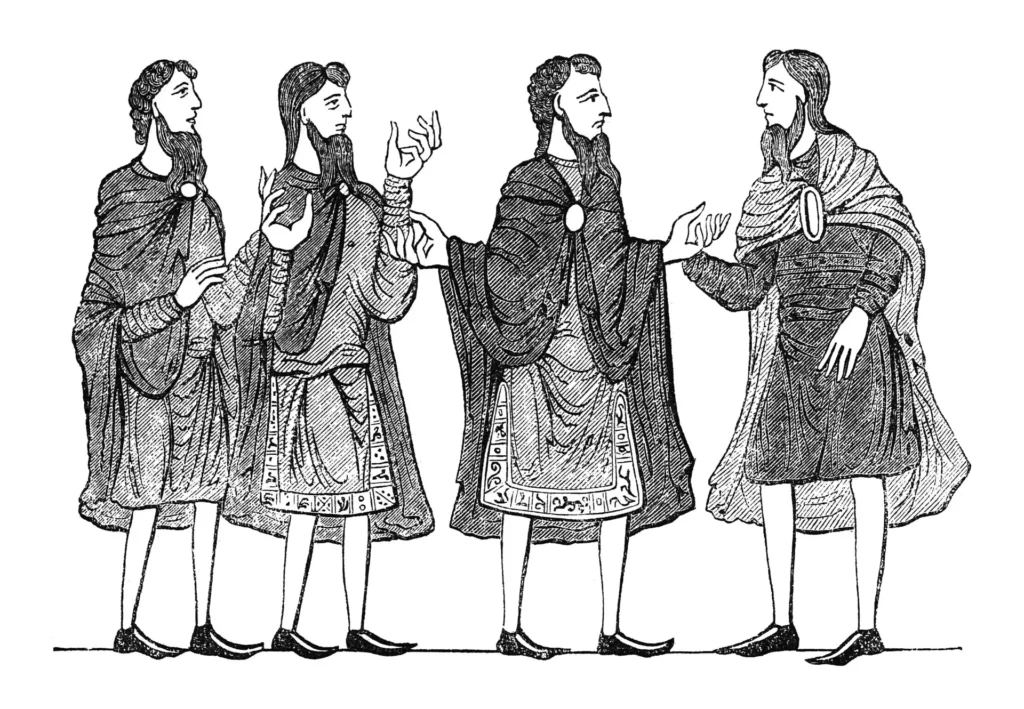
Part 1: Old English Period (450-1150)
The saga of English grammar begins with Old English, a period from the mid-5th century to the mid-12th century. This era, marked by the arrival of Germanic tribes (the Angles, Saxons, and Jutes) in Britain, laid the foundational stones of the English language. Old English, with its complex inflectional system and rich verbal palette, offers a window into the linguistic landscape of early medieval England.
Origins and Influences
Old English, or Anglo-Saxon, was predominantly a Germanic language, with its grammar heavily influenced by the dialects spoken by the tribes that settled in Britain. However, its evolution was not insular; interactions with Norse invaders and the Christianization of Britain introduced Norse and Latin elements into the language. These influences were not merely lexical but extended into the grammatical structure, introducing new syntactic constructions and vocabulary.
Grammatical Characteristics
The grammar of Old English is distinguished by its use of inflections to convey grammatical relationships. Nouns, adjectives, pronouns, and verbs were inflected for case, number, gender, and tense, a feature that made word order more flexible than in Modern English. For instance, the case system, with nominative, accusative, genitive, and dative cases, allowed for the subject, object, and possessive relationships to be understood through endings rather than sentence positions.
- Nouns: Old English nouns had three genders (masculine, feminine, neuter) and were declined in four cases.
- Verbs: Verbs were conjugated in several tenses with strong and weak forms, reflecting action and state through a rich array of verbal endings.
- Pronouns: Pronouns also reflected gender and case, providing nuanced ways to refer to subjects and objects within sentences.
Notable Texts and Examples
Though limited, the literature of the Old English period provides valuable insights into the grammar of the time. Works like “Beowulf,” one of the most celebrated epic poems of this era, not only illuminate the heroic culture of Anglo-Saxon England but also exemplify the grammatical norms of Old English. The “Anglo-Saxon Chronicle,” a historical record begun in the time of Alfred the Great, further showcases the language’s grammatical and syntactic conventions.
- Beowulf Example: “Hwæt! Wē Gār-Dena in gēardagum,” translated as “Lo! We have heard of the glory of the Spear-Danes in days of yore,” demonstrates the case and gender inflections typical of the period.
The Old English period established the grammatical bedrock of the English language. Despite the passage of centuries and the transformation of English through subsequent periods, echoes of Old English grammar linger in the modern language. The inflectional richness and syntactic flexibility of Old English, though largely streamlined in today’s English, remind us of its capacity to evolve while retaining ties to its historical roots. As we move into the Middle English period, we’ll see how external influences and internal changes further sculpted English grammar, paving the way for the language’s modern form.

Part 2: Middle English Period (1150-1500)
The transition from Old English to Middle English marks a significant chapter in the evolution of English grammar. It is characterized by profound changes influenced by historical events, notably the Norman Conquest of 1066. This period saw the infusion of Norman French into the English lexicon and grammar, significantly altering the structure and usage of the language.
Linguistic Shifts
The Norman Conquest brought about a linguistic division between the Anglo-Saxon ruling class and the Norman invaders, with French becoming the language of the court, law, and aristocracy. At the same time, English remained the language of the ordinary people. Over time, however, French began to permeate English, introducing new vocabulary and grammatical patterns. This bilingual environment facilitated simplifying the Old English inflectional system, leading to more fixed word order and gradually reducing gender and case distinctions in nouns.
Grammatical Changes
One of Middle English’s most notable grammatical changes was the loss of Old English’s extensive inflectional system characteristic. Nouns lost most of their case endings, except for the genitive (possessive) case, and the distinction between nominative and accusative cases became less pronounced. However, the agreement between subjects and verbs became more rigid, laying the groundwork for the modern subject-verb-object (SVO) word order.
- Verbs: The Middle English period also witnessed changes in verb conjugation, with a reduction in verb inflections and the beginning of the regularization of strong and weak verbs.
- Pronouns: Pronouns evolved to reflect changes in case usage, with the distinction between subjective (nominative) and objective cases becoming more defined.
Key Texts
The Middle English period produced a wealth of literature that reflects the evolving language. Geoffrey Chaucer’s “The Canterbury Tales” is perhaps the most iconic work of this era. It offers a rich tapestry of medieval society and a linguistic snapshot of Middle English in its variety and vitality.
- Example from The Canterbury Tales: “Whan that Aprill with his shoures soote / The droghte of March hath perced to the roote,” showcases Chaucer’s use of Middle English, with its simplified syntax and infusion of French-derived vocabulary.
Impact of the Printing Press
The latter part of the Middle English period saw William Caxton introduce the printing press to England in 1476, an innovation that played a crucial role in standardizing English spelling and grammar. The press helped disseminate literature and documents in English, fostering a sense of linguistic unity and slowly diminishing the regional dialects’ impact on written English.
The Middle English period was a time of significant linguistic transformation, where the intermingling of Anglo-Saxon and Norman French elements gave rise to a language that was increasingly recognizable as English. The simplification of grammar, the emergence of a more fixed word order, and the enrichment of the lexicon during this period were instrumental in shaping the English language’s development. As we proceed into the Early Modern English period, we witness the continued evolution of English grammar against the backdrop of the Renaissance, further technological advancements, and expanding geographical

Part 3: Early Modern English Period (1500-1700)
The journey through the evolution of English grammar leads us to the Early Modern English period, a time of profound linguistic, cultural, and intellectual ferment. From 1500 to 1700, this era was marked by the English Renaissance, an explosion of literature and learning that drew heavily on classical antiquity, and the advent of the printing press, which played a pivotal role in standardizing English spelling and grammar. This period witnessed significant shifts in English grammar, reflecting the dynamic interplay between linguistic innovation and the forces of standardization.
The Renaissance Influence
Reviving classical learning and literature, the Renaissance profoundly influenced the English language. Scholars and writers, enchanted by the works of ancient Greece and Rome, eagerly incorporated classical concepts and vocabulary into English, enriching the language and complicating its grammar with new forms and structures. This period of linguistic enrichment was also a time of increased grammatical experimentation as writers sought to express new ideas and emulate classical eloquence.
- Example: The introduction of Latin-based words and phrases into English, while expanding the language’s expressive capacity, also introduced inconsistencies in verb conjugation and noun declension, challenging the existing grammatical framework.
The Printing Press and Standardization
The introduction of the printing press to England by William Caxton in 1476 heralded a new era in the dissemination of written English. Books could be produced in large quantities for the first time, making literature more accessible and fostering greater literacy among the populace. The printing press’s role in standardizing English cannot be overstated; it helped fix the spelling and grammar of English at a time when regional dialects and variations still flourished. Printers and publishers, in their quest for a wider readership, favored a standardized form of English that could be understood across the country, gradually diminishing the influence of regional dialects in written language.
- Impact: The standardization facilitated by the printing press laid the groundwork for modern English grammar, establishing conventions and rules that would be elaborated upon in grammar texts and dictionaries.
Influential Grammar Texts
The Early Modern English period also saw the publication of the first English grammars, which sought to codify the rules of English grammar and spelling. These early grammars were often based on Latin models, reflecting the period’s classical aspirations but sometimes ill-fitting the vernacular English language’s structure.
- William Bullokar’s “Pamphlet for Grammar” (1586): Often credited as the first book to propose an English grammar, Bullokar’s work attempted to apply Latin grammatical principles to English, an approach that would be both influential and contentious among later grammarians.
The Early Modern English period was a crucible of linguistic change, where the forces of innovation, driven by the Renaissance’s intellectual currents, met the emerging imperative for standardization, propelled by the printing press and the first grammarians. This era’s legacy in shaping English grammar is profound, laying the foundations for the rules and conventions that govern modern English usage. As the language continued to evolve, the late Modern English period would see these foundations tested and expanded, reflecting its unceasing adaptability and speakers’ creative energies.

Part 4: Late Modern English Period (1700-1900)
Transitioning into the Late Modern English period, we witness a consolidation and expansion phase as efforts to standardize English grammar and spelling intensify alongside the language’s burgeoning global spread. This period, underscored by the Enlightenment and the Industrial Revolution, facilitated an unprecedented exchange of ideas, further enriching English and challenging its grammatical norms.
Standardization Efforts
The 18th and 19th centuries were marked by a genuine pursuit of linguistic clarity and uniformity, reflecting the Enlightenment’s broader emphasis on reason and order. Lexicographers and grammarians sought to codify English grammar and spelling, aiming to curb the variability that characterized its usage across different regions and social strata. This era saw the publication of influential dictionaries and grammar guides that sought to prescribe, rather than describe, English usage.
- Samuel Johnson’s “A Dictionary of the English Language” (1755): Johnson’s comprehensive work was a landmark in the standardization of English, offering not just definitions but also spelling conventions and usage examples, which helped fix the language’s form.
Grammatical Debates
Vigorous debates over the nature and direction of English grammar also characterized the period. Prescriptivist approaches, advocating for strict adherence to a set of established rules, clashed with emerging descriptivist perspectives, which argued for a more flexible understanding of grammar that accommodated variations in usage and recognized the language’s inherent dynamism.
- Prescriptive vs. Descriptive: These debates underscored a fundamental tension in grammatical theory — between the desire for order and the recognition of English as a living language, subject to change and variation.
Notable Grammar Guides
Several grammar guides from this period sought to elucidate and enforce grammatical rules, often drawing on Latin as a model for English grammar. These works played a significant role in shaping contemporary perceptions of grammatical correctness.
- Lindley Murray’s “English Grammar” (1795): Murray’s work, perhaps the most popular grammar guide of its time, epitomized the prescriptive approach, offering detailed rules and exercises designed to instill proper grammatical usage. His influence extended well into the 19th century, shaping the teaching and understanding of English grammar.
The Late Modern English period was a crucial phase in the evolution of English grammar, characterized by a dual movement towards standardization and global expansion. The efforts of lexicographers and grammarians to codify the language contributed significantly to forming a standard English, laying the groundwork for its role as a global lingua franca. However, the period’s grammatical debates also highlighted the tension between prescriptive norms and the descriptive realities of language use. This theme would continue to evolve in the centuries to follow. As English spread further, carried by the winds of empire and industry, it would encounter new influences and challenges, continually reshaping its grammar in response to the needs and realities of its diverse speakers.

Part 5: 20th Century to Present
The evolution of English grammar from the 20th century to the present day is characterized by significant shifts towards inclusivity, descriptivism, and global diversity. This period, marked by rapid technological advancements, globalization, and increasing awareness of linguistic diversity, has seen English grammar become more reflective of its status as a global lingua franca, accommodating a wide array of dialects and sociolects.
The Rise of Descriptive Grammar
The 20th century heralded a significant shift in the approach to English grammar, moving away from the prescriptive norms that dominated previous centuries to a more descriptive understanding of grammar. Influenced by the work of linguists like Ferdinand de Saussure and later Noam Chomsky, this period recognized the importance of describing language as it is used by its speakers rather than prescribing how it should be used. This approach acknowledges the fluidity and variability of English grammar, reflecting the language’s adaptability and capacity to evolve.
- Linguistic Studies: Pioneering studies in linguistics provided insights into the innate structures of language, challenging rigid grammatical rules and highlighting the creative capacities of individual speakers.
Influence of Technology
The latter half of the 20th and early 21st centuries witnessed unparalleled technological advancements, significantly impacting how English is used and perceived. The advent of digital communication, including the internet, social media, and text messaging, introduced new linguistic forms and grammatical structures, further diversifying English grammar.
- Digital Communication: The concise nature of digital communication mediums fostered the emergence of abbreviated language forms and unconventional grammatical structures, challenging traditional notions of grammatical correctness.
Modern Grammar Resources
The accessibility of information and the proliferation of educational resources online have democratized knowledge about English grammar. Online platforms, grammar-checking software, and interactive learning tools offer users instant feedback on their writing, promoting a more informed understanding of grammar.
- Grammar Checking Software: Tools like Grammarly and the Hemingway Editor have become ubiquitous, providing users with real-time corrections and suggestions that reflect traditional grammar rules and the nuances of modern usage.
Global English and Future Trends
As English continues to function as a global lingua franca, its grammar is increasingly influenced by the practices of non-native speakers, leading to the emergence of “Global Englishes.” This development challenges the dominance of native-speaker norms, suggesting a future in which English grammar is even more diverse and inclusive.
- Global Varieties of English: Recognizing global varieties of English, each with its grammatical nuances, underscores the language’s capacity for adaptation and change, reflecting its speakers’ diverse experiences and cultures.
From the 20th century to the present, the evolution of English grammar has been marked by significant changes that reflect broader social, technological, and intellectual developments. The shift towards descriptive grammar, influenced by advances in linguistics and the rise of digital communication, has fostered a more inclusive and flexible understanding of English grammar. As we look to the future, the ongoing globalization of English and the rise of digital communication will likely transform its grammatical landscape further, reflecting its role as a versatile and dynamic global language. The story of English grammar, far from complete, continues to evolve, mirroring the complexities and diversities of the human experience.

Part 6: Global English and Future Trends
As English continues to cement its status as a global lingua franca, its grammar is concurrently experiencing an expansion influenced by its diverse global speakers. This phenomenon, often encapsulated in the “Global Englishes” discussion, reflects the language’s wide-reaching spread and adaptability to diverse cultural, social, and linguistic landscapes. This part explores the implications of English’s global spread for its grammar and considers future trends that may further shape its evolution.
Global Varieties of English
The proliferation of English across continents has given rise to numerous regional varieties, each with unique grammatical nuances. From the rhythm and syntax of Indian English to the vocabulary and spelling preferences of British and American English, these global varieties enrich the tapestry of English grammar. This diversification challenges the traditional notion of standardized English grammar, promoting a more pluralistic view of correct usage that accommodates regional differences.
- Impact on Grammar: The interaction between native and non-native English speakers worldwide is leading to grammatical innovations and variations, including new verb forms, the use of prepositions, and article usage, reflecting the dynamic interplay between global and local linguistic practices.
The Future of English Grammar
The future of English grammar appears to be marked by increased fluidity and inclusivity. Technological advancements, especially in AI and machine learning, promise to democratize language learning and usage further, potentially standardizing specific grammatical structures across global English varieties while introducing new forms influenced by digital communication.
- Technological Influences: Emerging technologies are not only tools for learning and correction but also agents of linguistic change, capable of preserving and evolving grammatical norms based on vast datasets of global English usage.
- Sociolinguistic Shifts: As societies become increasingly multicultural, English grammar will likely continue to evolve to reflect the diverse identities and communicative needs of its speakers, challenging traditional prescriptive norms with more descriptive, fluid practices.
Preserving vs. Evolving
A key question for the future of English grammar is the balance between preserving the linguistic heritage of English and embracing its evolution as a global language. While standardization has its merits, especially in educational and professional contexts, the vitality of English lies in its capacity for change and adaptation. The future of English grammar will likely be shaped by a dialogue between these forces, with grammatical norms reflecting a compromise between historical continuity and the innovative spirit of a global community of speakers.
The journey of English grammar from the Old English period to its current global expanse is a testament to the language’s remarkable adaptability. As English continues to evolve in the hands of its diverse international community, its grammar remains at the heart of this evolution, reflecting changes in technology, communication, and societal norms. Looking ahead, the future of English grammar will be shaped by the ongoing negotiation between the desire for a common standard and the celebration of linguistic diversity.
This evolving grammar, far from being a set of rigid rules, is a living, breathing entity that mirrors the complex, interconnected world it serves. Therefore, the story of English grammar is not just about the past or present but is intrinsically linked to the future—charting a course through uncharted linguistic territories, propelled by the creativity and innovation of its speakers worldwide.

Part 7: Understanding Grammar’s Role in Society
The evolution of English grammar is not merely a linguistic journey; it’s deeply intertwined with societal shifts, reflecting and shaping cultural identities, power dynamics, and educational philosophies. This final part explores the multifaceted role of grammar in society, highlighting its significance beyond the confines of linguistic structure to its broader social, political, and cultural implications.
Grammar and Identity
Grammar is a critical element of linguistic identity, often representing social class, education level, and regional background. Variations in grammar usage can signify membership in particular communities or differentiate between social groups. For instance, using non-standard grammatical forms can be a source of pride, embodying cultural heritage and community identity. Still, it can also be stigmatized, reflecting broader societal prejudices and inequalities.
- Dialects and Standard English: The tension between regional dialects and what is considered “Standard English” underscores the complex interplay between language, identity, and power. Efforts to standardize grammar often intersect with social hierarchies, privileging certain forms of speech over others.
Grammar in Education
Teaching grammar in educational settings reflects societal values and goals, shifting emphases between prescriptive rules and creative expression. How grammar is taught—as a rigid set of rules to be followed or as a flexible system to be explored—influences students’ relationship with language, creative and analytical skills, and confidence in communication.
- Prescriptive vs. Descriptive Approaches: Debates over grammar instruction often mirror broader educational philosophies, balancing the need for standardization and effective communication with the recognition of linguistic diversity and the importance of fostering individual voice.
The Politics of Grammar
Grammar standardization and regulation are not merely academic concerns; they have political dimensions as well. Language policies, including grammar, can serve as tools of cultural imperialism or assimilation but can also be instruments of resistance and decolonization. Promoting specific grammatical standards over others can reinforce or challenge power structures, making grammar a site of political contestation.
- Language Policy and Cultural Identity: The imposition or promotion of particular grammatical standards in multilingual societies can have profound implications for cultural preservation and identity politics, highlighting the need for sensitive and inclusive language policies.
Concluding The Evolution of English Grammar
As we conclude our exploration of “The Evolution of English Grammar,” it becomes evident that grammar is far more than a set of linguistic rules; it reflects human society in all its complexity. The journey of English grammar, from its origins to its present global form, encapsulates the interplay between linguistic innovation, societal change, and the quest for identity and belonging. As English evolves, shaped by technological advances, global communication, and social movements, so will its grammar, reflecting its speakers’ changing realities and aspirations.
The study of English grammar’s evolution reminds us of the language’s resilience and adaptability, its capacity to incorporate and be reshaped by diverse influences. It challenges us to view grammar not as a static set of prescriptions but as a dynamic system that can accommodate the richness of human expression. As we move forward, the future of English grammar promises to be as varied and vibrant as the communities that speak it, a testament to the enduring power of language to connect, convey, and transform.

Further Exploration
For those eager to dive deeper into the intricacies of English, countless resources await. From comprehensive grammar guides to interactive language learning platforms, the tools at your disposal are more accessible than ever. Engage with these materials, challenge yourself with new exercises, and remain curious and open to discovery. We offer a line of comprehensive grammar and punctuation courses and feature a mastery quiz bundle to cement your further mastery of grammar and punctuation. Feel free to access the endorsed resources below to enhance your learning experience.


