
Grammar Trivia and Fun Facts
Can one word be a complete sentence? Can the same word mean its own opposite? Explore 24 oddities of English grammar, punctuation, and word history, then see how many you can solve.
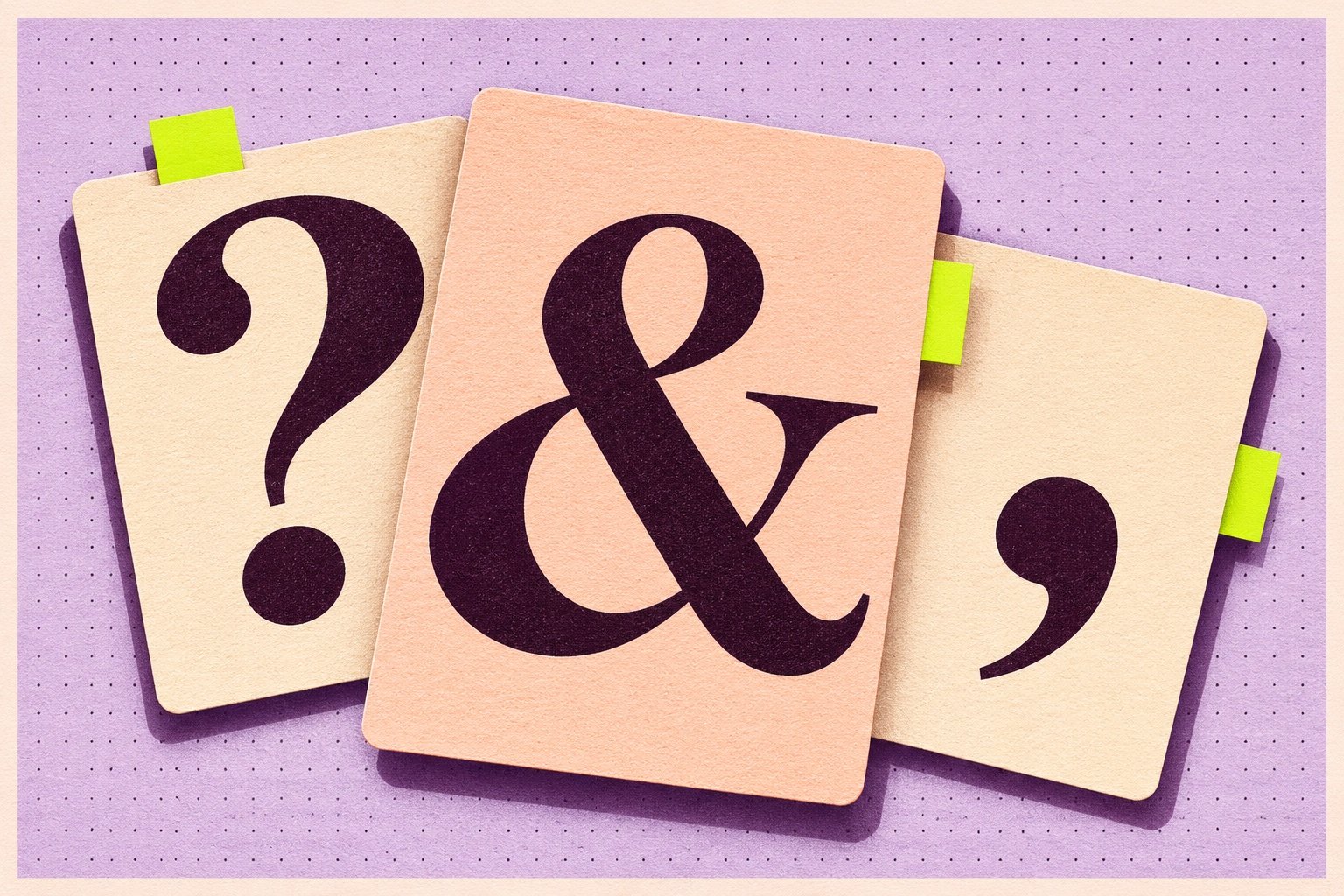
Small changes, big meanings.
Try reading each example aloud. A single mark or sound can change who’s speaking, who’s being addressed, or what the sentence means.
“Go.” is a complete sentence.
It’s an imperative, a sentence that gives a command or instruction. The person being addressed is understood to be the subject. “Wait.” and “Run!” work the same way.
Go. → The listener is the one who should go.A comma can rescue Grandma.
In the second sentence, the comma sets off the person you’re speaking to. In the first, Grandma is the object of eat.
Let’s eat Grandma. → Let’s eat, Grandma.The Oxford comma can clear up a guest list.
It’s the final comma before and or or in a list of three or more. In “I thanked my parents, the baker and the mayor,” the baker and mayor could be read as the parents. The final comma helps separate the three entries.
I thanked my parents, the baker, and the mayor.Your ears choose “a” or “an.”
The first sound of the next word decides. Hour begins with a vowel sound. Unicorn begins with the consonant sound you hear at the start of yes.
An hour. A unicorn. An MRI. A USB cable.Opinion usually comes before color.
“A lovely red coat” sounds ordinary. “A red lovely coat” sounds marked. English adjective order has strong preferences, though emphasis and context can shift them.
A lovely little red coat.One sheep, two sheep.
Some English nouns have the same singular and plural form. Look to the words around them for clues about number. Deer and species do this, too.
One sheep is asleep. Two sheep are asleep.English plays tricks on your eyes.
Some words change their sound with their meaning. Others run in both directions or pack the whole alphabet into one line.
“Dust” can add or remove.
A contronym has senses that can point in opposite directions. Dusting a shelf removes a layer. Dusting a cake with sugar adds one.
Dust the shelf. Dust the cake with sugar.You can wind up fighting the wind.
Wind as moving air sounds like “win” with a d. Wind as in winding a clock rhymes with find. Context tells you which pronunciation to use.
Wind the clock while the wind howls.One fox covers the alphabet.
A pangram uses every letter of an alphabet. The quick brown fox is the familiar English example. A pangram gives you a compact way to see all the letters in a font.
The quick brown fox jumps over the lazy dog.“Never odd or even” runs both ways.
Ignore spaces and capitalization, and this phrase reads the same backward and forward. Shorter examples include level and radar.
NEVERODDOREVEN“Bookkeeper” has a triple double.
Three pairs of repeated letters sit side by side. You can find the same sequence in bookkeeping.
boo·kk·eeper“Ough” has several voices.
Compare the ending sounds of though, through, rough, and bough. The spelling is shared. The sounds vary, and accent can affect how some examples are pronounced.
Though · through · rough · boughEvery little mark has a story.
Some clues to English’s history are hiding in the marks and expressions we use every day.
The ampersand’s name was once a phrase.
Ampersand comes from and per se and, which identifies the symbol by saying it means “and” on its own. The shape developed from joined letters in Latin et, meaning “and.”
Latin et → &The dot over “i” has a name.
It can be called a tittle, a term for a small mark in writing or printing. The dot on a lowercase j goes by the same name.
i jSingular “they” has a long history.
English has used they for an unspecified individual for centuries. It also refers to a specific person who uses they as their pronoun.
Someone left their notebook.“OK” started as a spelling joke.
One of the earliest recorded uses appeared in the Boston Morning Post in 1839. The initials stood for oll korrect, a playful misspelling of all correct.
Oll korrect → OKSpanish marks both ends of a question.
In Spanish, a direct question opens with an inverted question mark and closes with a regular one. The opening mark tells you where the question begins.
¿Dónde está el libro? · Where is the book?“Emoji” has two plurals.
English borrowed emoji from Japanese and uses both emoji and emojis as plurals. A word borrowed into English can pick up an English plural ending while another form remains in use.
I sent three emoji. I sent three emojis.Six “rules” with a twist.
Some familiar rules describe useful habits. Others leave out choices that good writers make every day.
“Octopuses” is a standard plural.
Octopi is also listed by Merriam-Webster, along with octopodes in some senses. Octopuses is an easy choice for general writing.
We spotted two octopuses near the reef.You can end a sentence with “for.”
“What are you looking for?” is ordinary English. A form such as “For what are you looking?” can feel formal or stiff. Choose the order that suits your reader.
Explore sentence-ending prepositions →An infinitive can be split.
An adverb can sit between to and the verb. “She decided to gradually cut back” puts gradually next to the action it describes.
Explore split infinitives →“But” can begin a sentence.
Starting with but makes a contrast easy to hear. Try it when you want the next thought to stand on its own.
We planned to walk. But the trail was closed.The passive voice has a purpose.
“The window was broken overnight” puts the window first and leaves the actor unstated. That’s useful when you’re reporting damage and nobody saw who caused it.
Compare active and passive voice →“Less than three hours” works.
Fewer is a useful default for separate countable items, as in “fewer meetings.” Less is common with amounts treated as a whole, including measurements of time, distance, or money.
Fewer meetings. Less than three hours.Can you solve all four?
Make your guess, then open the question to check your answer.
01. What is the verb in “The old man the boat”?
Man. Here it means to operate or crew. The old means the older people. Your brain may initially read old man as a noun phrase, which is what makes this a garden-path sentence.
02. Which is right, “a one-time fee” or “an one-time fee”?
A one-time fee. One starts with a w sound.
03. Can “I saw the detective with binoculars” mean two things?
Yes. You might have used binoculars, or the detective might have been carrying them. “Through my binoculars, I saw the detective” makes the first meaning clear.
04. Change COLD to WARM, one letter at a time.
COLD → CORD → CARD → WARD → WARM. Each step changes exactly one letter and leaves a valid word.
Sources and further reading
- Cambridge English Grammar Today on imperative clauses and a and an
- Oxford English Dictionary on the history of singular they
- Merriam-Webster entries for ampersand, OK, emoji, and octopus
- FundéuRAE on Spanish question and exclamation marks
- Read more in the Grammar Glossary and Common Grammar Myths
